


Peach-flavored tofu cat litter is a Plant-based cat litter product that combines a tofu-style absorbent base with a peach-inspired fragrance. It is designed for cat owners who prefer plant-derived litter materials and want an alternative to unscented products or conventional mineral-based cat litter.
Tofu cat litter is commonly manufactured using plant fibers, such as soybean-processing residue or pea-derived fiber, together with suitable binders and other formulation ingredients. The materials are processed into granules or pellets intended to absorb moisture and, in many formulations, form clumps that can be removed during routine litter-box cleaning.
The peach scent is a distinguishing feature of this product category. Depending on the formulation, it may come from an added fragrance or
another scenting ingredient. The term “peach-flavored” is generally used as a product description for the aroma; it does not necessarily mean that the litter contains peach fruit, peach pulp, or peach extract. Buyers should consult the ingredient list to determine the actual composition.
Peach-flavored tofu cat litter may appeal to consumers looking for a scented plant-based litter with a fruity fragrance. However, fragrance is only one part of product performance. Absorption, clumping strength, dust generation, tracking, storage stability, ingredient transparency, and the cat's willingness to use the litter are equally important.
For retailers, distributors, importers, and private-label brands, peach-flavored tofu cat litter can serve as a fragrance variation within a broader cat litter portfolio. Its commercial suitability depends on the product's verified performance, fragrance consistency, packaging, pricing, and target-market preferences.
The basic functions of peach-flavored tofu cat litter come from its absorbent material and formulation. The peach aroma provides a scent profile, but it should not be assumed to provide the primary moisture-absorption or clumping function.
The plant-based granules are designed to take up liquid when a cat urinates in the litter box. Their performance depends on the material composition, porosity, particle dimensions, density, moisture content, and processing conditions.
A well-formulated litter should absorb liquid under its intended conditions of use and help keep the remaining litter manageable. However, products described as “highly absorbent” can perform differently depending on their formulas and test methods.
Buyers should evaluate absorption using a consistent procedure. Important factors include the amount of litter tested, the liquid volume, the contact time, drainage conditions, and the way the result is calculated.
Many tofu cat litter products are designed to form clumps after absorbing urine. These clumps allow users to remove contaminated material with a scoop while leaving most of the clean litter in the box.
Clumping performance depends on the base material, binder system, granule structure, moisture level, and time allowed for the clump to form.
A useful evaluation should examine whether clumps remain intact when lifted, whether wet material sticks to the bottom of the box, and whether the clumps break apart during normal cleaning.
Peach-flavored tofu cat litter should not automatically be assumed to have a particular clumping speed or strength. These characteristics need to be confirmed for the specific formulation.
The peach-inspired fragrance creates a fruity scent profile. Fragrance intensity can range from subtle to relatively strong, depending on the formulation and dosage.
A peach aroma does not necessarily mean that a product removes odor-causing compounds. Fragrance can change or mask the smell perceived by a person, while effective odor management may also depend on moisture absorption, waste removal, ventilation, and any tested odor-control ingredients.
For this reason, fragrance performance and odor-control performance should be evaluated separately.
Dust can develop when fine particles separate from granules during production, transportation, pouring, or use. Tracking occurs when granules or fragments are carried outside the litter box on a cat's paws or fur.
Particle size, shape, surface texture, granule strength, and screening methods may affect these characteristics. Testing the finished, packaged product is more informative than relying on the raw material description alone.
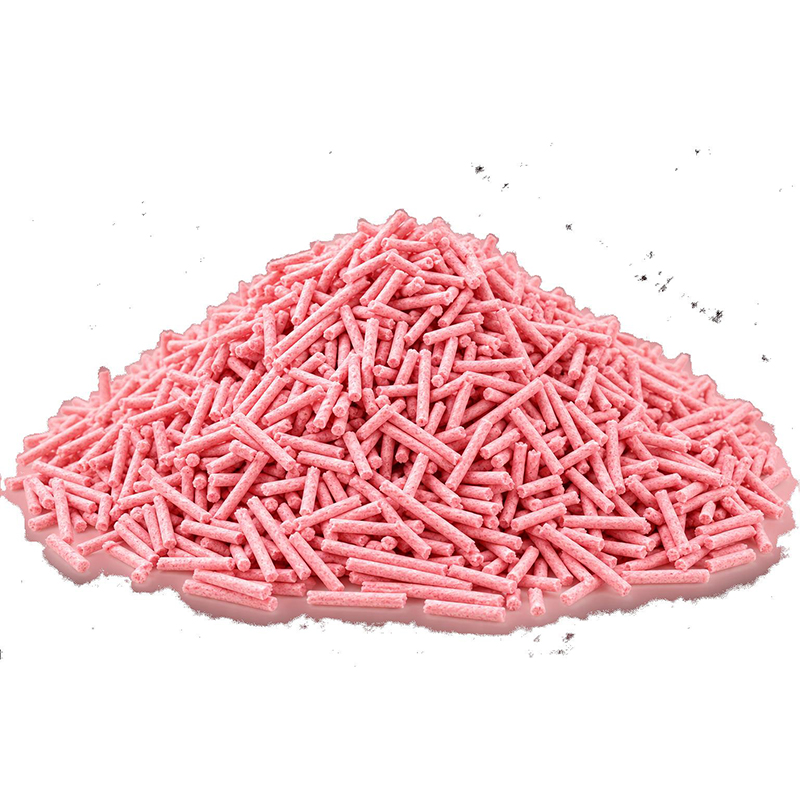
The exact composition of peach-flavored tofu cat litter varies among manufacturers. Understanding the formulation helps consumers and commercial buyers evaluate the product more accurately.
Tofu-style cat litter is commonly associated with plant-derived fibers, including soybean-processing residue and pea fiber. Some products may use corn-derived starch, other plant materials, or combinations of ingredients to achieve the desired structure and performance.
The choice of material influences granule formation, absorption, density, and resistance to breakage. A consistent supply of suitable raw materials is important for maintaining finished-product quality.
When evaluating a product, buyers should ask:
What is the main absorbent material?
Which binders and processing aids are used?
Does the formulation contain soybean-derived, pea-derived, or other plant fibers?
How is raw material moisture controlled?
What quality checks are performed before and after production?
Are ingredient details available for the destination market?
The term “tofu cat litter” alone does not establish that a product is made entirely from tofu residue. The actual ingredient list should be used to determine its composition.
The peach scent may be produced using a fragrance system designed to create a fruity aroma. The exact ingredients, concentration, and fragrance profile depend on the manufacturer.
A peach-inspired fragrance should be selected for its intended use in cat litter, with appropriate product documentation and safety assessment. The presence of a pleasant aroma does not by itself establish that the fragrance is suitable for every cat.
Fragrance quality should be assessed in terms of consistency, intensity, storage stability, and compatibility with the litter base. If the aroma changes significantly during storage or varies between production batches, customer experience may become inconsistent.
Binders help hold the plant-derived materials together during pellet or granule formation. Depending on the formulation, starches or other suitable binding materials may be used.
The binder system can influence clump formation, granule durability, moisture response, and the amount of residue left during scooping.
A strong granule is not necessarily the best granule for every application. The product should balance durability during shipping with suitable absorption and clumping during use.
Some formulations may include other ingredients intended to support odor management, granule stability, or production performance.
These ingredients should be identified in the product documentation. Buyers should not assume that all peach-flavored tofu cat litter contains activated carbon, antibacterial agents, or any particular odor-control additive.
If a supplier makes claims about an additional functional ingredient, request details about its role and any relevant test results.
Peach-flavored tofu cat litter combines a plant-based litter format with a peach-inspired aroma. The following are potential product characteristics; the exact features depend on the individual formulation.
The peach scent distinguishes this litter from unscented tofu litter and other fragrance varieties. It may appeal to consumers who prefer fruity fragrance profiles.
However, fragrance preference is subjective. Some cats may tolerate scented litter, while others may avoid products with unfamiliar or strong aromas.
Tofu cat litter is commonly developed using plant-derived materials. This may appeal to consumers seeking alternatives to conventional clay-based litter.
Nevertheless, a plant-based composition does not automatically establish that the finished product is compostable, flushable, or suitable for every disposal method. Those claims require separate verification.
If the product is a clumping formulation, users can remove urine clumps and solid waste without discarding the entire litter-box contents after each use.
The practical benefit depends on the integrity of the clumps, the amount of residue left behind, and the quantity of clean litter removed during scooping.
Tofu cat litter may be available in different pellet sizes and shapes. Depending on the supplier, options may include relatively fine cylindrical pellets or larger granules.
The right format depends on absorption, tracking, user preference, and the cat's acceptance. Buyers should confirm the actual dimensions rather than assuming a standard size.
Peach-flavored tofu cat litter can potentially be offered in retail pouches, resealable bags, larger household packages, or bulk formats.
The best packaging configuration depends on the intended sales channel, product weight, shipping requirements, shelf presentation, and storage conditions.
Some consumers prefer Scented cat litter because they want a recognizable fragrance in the room where the litter box is located. Peach-flavored tofu cat litter offers a fruity alternative to unscented or other scented formulations.
The scent should remain a secondary consideration to the cat's comfort. A strong fragrance is not proof of better odor control.
Clumping formulations can make daily litter-box maintenance more straightforward. Users can scoop out urine clumps and solid waste, then replenish the remaining litter as needed.
The actual convenience depends on clump strength, the amount of residue, and the product's behavior after repeated use.
Plant-based tofu litter provides another material option for consumers comparing litter types. Some users may prefer its texture, weight, or handling characteristics.
No single litter material is ideal for every cat or household. A product should be assessed according to the cat's habits, cleaning routine, and the household's preferences.
When clumps remain intact, users may be able to remove contaminated material without discarding as much clean litter. This can help make litter use more efficient.
Actual consumption depends on the product's formulation, the number of cats, litter-box size, cleaning frequency, and how much litter is removed with each scoop.
Peach-flavored tofu cat litter can add a fruity fragrance option to a product range that includes unscented tofu litter and other scent variations.
Retailers should assess customer demand, repeat purchases, product quality, and packaging appeal before expanding the range.
Specifications help buyers compare products, define quality requirements, and establish purchasing standards.
The following table is a procurement template. It is not a claim about the specifications of any particular peach-flavored tofu cat litter product.
| Specification | What to Confirm |
|---|---|
| Product name | Peach-flavored tofu cat litter |
| Main absorbent material | Exact plant-derived ingredients |
| Fragrance system | Peach fragrance or other disclosed scenting ingredient |
| Granule shape | Cylindrical pellet, stick, or other format |
| Granule dimensions | Actual measured size range |
| Absorption performance | Test result, method, and acceptance criteria |
| Clumping performance | Clump integrity and ease of removal, if applicable |
| Dust level | Defined test method and measured result |
| Moisture content | Actual specification and permitted tolerance |
| Fragrance intensity | Agreed evaluation criteria |
| Product color | Confirmed standard appearance |
| Package weight | Net weight and allowable tolerance |
| Packaging material | Bag structure, closure, and moisture protection |
| Shelf life | Manufacturer-validated shelf-life information |
| Storage guidance | Required temperature and moisture conditions |
| Disposal instructions | Verified methods and applicable restrictions |
| Quality documentation | Relevant ingredient information and test reports |
Numerical specifications are only useful when the measurement methods are clear.
For example, absorption values may differ according to the liquid used, contact time, sample mass, drainage procedure, and calculation formula. Dust measurements may also differ depending on the particle-size threshold and test equipment.
Buyers should request both the result and the test method. When comparing suppliers, use the same testing conditions wherever possible.
A purchase specification should identify the product characteristics that matter most to the intended market. These may include moisture content, granule dimensions, absorption, clump integrity, dust level, and fragrance consistency.
The acceptable range for each parameter should be established with the supplier before mass production. It should not be invented from general product descriptions or competitor claims.
Absorption affects moisture management, litter-box cleanliness, and the performance of clumping products.
Absorption rate describes how quickly the litter takes up liquid under defined conditions. Faster absorption may help reduce the amount of free liquid remaining on the surface, but speed alone does not determine overall quality.
A standardized test should define the sample mass, liquid volume, contact time, and measurement procedure.
Absorption capacity indicates how much liquid a quantity of litter can retain under specified conditions. It may be expressed as a ratio or percentage, depending on the testing method.
Because methods vary, buyers should avoid comparing figures from different suppliers unless the test procedures are equivalent.
For clumping peach-flavored tofu cat litter, the resulting clump should be assessed after moisture absorption.
A practical evaluation can record:
Whether the clump forms consistently.
Whether it remains intact during lifting.
Whether wet material sticks to the litter-box bottom.
Whether excessive residue remains after scooping.
How much clean litter is removed with the clump.
A product that absorbs liquid well but produces weak clumps may still be inconvenient to use.
A litter may behave differently after several days of use than it does in an initial test. Repeated-use evaluation can help identify excess residue, changes in texture, persistent odors, or deterioration of the remaining litter.
Commercial buyers should combine laboratory measurements with realistic usage observations.
The peach scent is a defining feature of this product category, but fragrance and odor management should be considered separately.
A peach fragrance changes the scent perceived by the user. It may mask some unpleasant odors, but it does not necessarily remove the compounds responsible for them.
Odor management may also depend on the litter's ability to absorb moisture, the removal of waste, ventilation, and any additional ingredients that have been tested for odor-control performance.
Product descriptions should distinguish among fragrance, odor masking, and demonstrated odor reduction.
A mild fruity aroma may be preferred by some households, while others may want a more noticeable scent. The ideal intensity is subjective and should not be assumed to suit every cat.
Manufacturers should control fragrance dosage and consistency. Buyers should evaluate samples under ordinary conditions and check whether the aroma remains stable during storage.
Even a well-formulated litter requires regular maintenance. Remove solid waste and urine clumps as frequently as necessary, replenish litter as needed, and clean the box according to product instructions.
A scented litter can still become unhygienic if waste is left in the box for too long. Aroma should not be used as the sole indicator of cleanliness.
For B2B buyers, odor-control claims should be supported by defined evaluation methods. Useful information includes the test conditions, comparison product, duration, sample size, and assessment criteria.
If a supplier claims extended odor control, ask how the duration was established and what conditions apply. Avoid translating a controlled test into a universal guarantee for every household.
Dust and tracking affect both the cleanliness of the home and the user experience.
Fine particles may originate from raw material processing, pellet formation, drying, screening, transport, and handling. Granules can also break down during normal use.
Manufacturing controls may include screening, appropriate granule formation, and finished-product inspection. The actual result should be confirmed through testing.
Terms such as “low dust” and “dust reduced” should be supported by a clear measurement method.
Buyers should ask how the sample is handled, which particles are measured, and whether the result represents the product as packaged. A visual inspection may not identify all fine particles.
Where dust performance is important, documented measurements are more useful than broad marketing language.
Tracking happens when granules or fragments adhere to a cat's paws or fur and are carried away from the box.
Particle size, shape, surface texture, and granule durability may influence tracking. A litter mat can help collect loose particles, although it will not eliminate tracking completely.
Smaller pellets may feel different from larger pellets under a cat's paws. Some cats may prefer one texture over another.
The most suitable granule size should balance absorption, clumping, tracking, and cat acceptance. Buyers should assess these factors together instead of selecting a product based on size alone.
Ingredient transparency is important because cats interact closely with their litter and may lick their paws during grooming.
The term “peach-flavored” does not necessarily mean that the product contains real peach fruit. It may refer to a fragrance designed to produce a peach-like aroma.
Buyers should confirm the exact formulation, including the fragrance system and any additional functional ingredients. The manufacturer should provide appropriate documentation for the product's intended use.
Cats may react differently to scented products. Some may tolerate a peach aroma, while others may find it unfamiliar or unpleasant.
If a cat repeatedly avoids the litter box or shows concerning signs after a product change, stop using the new product and seek veterinary advice when appropriate. These behaviors can have several causes, so they should not automatically be attributed to fragrance.
Cat litter is intended for litter-box use, not as food. Keep the product out of reach of children and prevent pets from chewing or deliberately eating the granules.
If a cat consumes a substantial amount of litter or develops concerning symptoms after ingestion, contact a veterinarian for guidance.
Retailers and distributors should request relevant ingredient information, safety documentation, and applicable test reports.
Avoid unsupported claims such as “100% safe,” “chemical-free,” or “completely harmless.” Accurate, evidence-based product descriptions are more appropriate than absolute safety guarantees.
Kittens may explore unfamiliar materials by chewing or mouthing them. For young cats, buyers should pay particular attention to ingredient transparency, granule characteristics, fragrance, and the manufacturer's use guidance.
An unscented product may be a more suitable option for cats that are sensitive to fragrances or have difficulty accepting a scented litter. Consult a veterinarian if there are concerns about ingestion or litter-box behavior.
Tofu cat litter is often marketed as a plant-based alternative, but the environmental characteristics of the finished product depend on its complete formulation.
The plant-derived base may break down under suitable conditions. However, fragrances, binders, coatings, and other additives can affect the behavior of the complete product.
Biodegradability and compostability are not interchangeable claims.
A material may biodegrade under certain environmental conditions, while compostability generally involves additional requirements and a defined process. Buyers should request relevant evidence before using specific environmental claims.
Cat waste may contain pathogens, and disposal guidance varies by location and intended compost use. Do not assume that used cat litter is suitable for home composting or for compost intended for food-growing areas.
A plant-based composition does not automatically make litter suitable for flushing.
Plumbing systems, wastewater infrastructure, septic systems, and local regulations vary. Even material that breaks apart in water can cause problems in an unsuitable system or when excessive quantities are flushed.
Follow the product's explicit instructions and local wastewater guidance. If flushability has not been clearly established, use an approved solid-waste disposal method.
Manufacturers and sellers should distinguish between plant-derived content, biodegradability, compostability, and flushability.
For example, “made with plant-derived materials” describes the source of some ingredients. “Certified compostable” is a more specific claim that requires appropriate supporting evidence.
Clear terminology helps buyers understand the product and reduces the risk of misleading environmental claims.
Correct use can help maintain litter-box hygiene and make it easier to assess whether the product suits a particular cat.
Wash and dry the litter box before introducing a new product. Avoid leaving strong cleaning-product residues that may discourage the cat from entering.
Choose a box that allows the cat to enter, turn around, dig, and cover waste comfortably.
Follow the manufacturer's instructions for litter depth. If the product documentation does not specify a suitable depth, ask the supplier for guidance based on the granule format and clumping behavior.
Too little litter may allow liquid to reach the bottom of the box. Excessive depth may increase scattering or waste product.
Cats may be sensitive to changes in texture and scent. If the cat already uses another litter, consider introducing the new product gradually while monitoring acceptance.
Increase the proportion of the new litter over time if the cat tolerates the change. Some cats may need a longer transition period, and some may prefer to return to an unscented product.
Remove solid waste and urine clumps at an appropriate frequency. For clumping formulations, allow sufficient time for clumps to form before scooping, following the product instructions.
Remove broken clumps and contaminated material instead of leaving residue in the box.
Add fresh litter as needed to maintain the recommended depth. Replace the litter and clean the box at suitable intervals based on the manufacturer's instructions and actual hygiene conditions.
A peach aroma does not mean the litter is still clean. Regular maintenance remains necessary even when the scent is noticeable.
Monitor whether the cat enters the box normally, digs comfortably, and continues its usual elimination habits.
If the cat consistently rejects the new litter, do not force continued use. Persistent litter-box avoidance or signs of discomfort may warrant veterinary assessment.
Different litter materials have different characteristics. The following comparison is general; actual performance depends on the formulation and testing.
| Litter Type | Typical Material | Common Characteristics | Main Considerations |
|---|---|---|---|
| Peach-flavored tofu cat litter | Plant-derived tofu litter base with peach-inspired fragrance | Scented plant-based format; may be clumping | Confirm fragrance ingredients, clumping, and cat acceptance |
| Unscented tofu cat litter | Plant-derived tofu litter base | Similar material category without added scent | May suit households that prefer to avoid fragrance |
| Other scented tofu litter | Plant-derived base with another fragrance | Offers alternative scent profiles | Fragrance intensity and ingredient transparency matter |
| bentonite cat litter | Clay-based mineral material | Commonly available in clumping formulations | Weight, dust, tracking, and disposal vary |
| Silica gel cat litter | Porous silica-based granules | Designed to absorb moisture; formats vary | Texture acceptance and disposal guidance matter |
| Pine cat litter | Processed wood-based material | Available in pellet and other formats | Absorption, breakdown, and scent differ by product |
| Paper cat litter | Processed paper fibers | Often available in non-clumping formats | Moisture handling and replacement frequency vary |
| Cassava cat litter | Cassava-derived plant material | Plant-based alternative; some products clump | Composition, performance, and price vary |
| Corn-based cat litter | Corn-derived plant material | May offer clumping and plant-based characteristics | Ingredient transparency and storage conditions matter |
The main difference is the scent profile or additional fragrance ingredients, not necessarily the absorbent base.
If both products use comparable base formulations, their absorption and clumping behavior may be similar. However, added fragrance or other ingredients can affect the finished product, so performance should be verified.
Peach-flavored tofu cat litter may appeal to consumers who prefer fruity scents. Unscented tofu litter may be a better choice for cats or households that want to avoid added fragrance.
Bentonite litter is a mineral-based category often associated with clumping products. Tofu litter uses plant-derived materials and may have different handling, weight, and disposal characteristics.
Neither category is universally superior. Compare absorption, clump strength, dust, tracking, total cost, and cat acceptance.
Pine litter generally uses wood-derived materials, whereas tofu litter is commonly based on plant fibers associated with soybean or pea processing.
The two categories can differ in texture, natural aroma, and breakdown behavior. The appropriate option depends on the cat's preferences and the user's cleaning routine.
Paper litter is often made from processed paper fibers and may be available in non-clumping formats. Tofu litter is frequently offered as a clumping product, although formulations vary.
Buyers should compare the actual products rather than assuming every litter within a category has identical characteristics.
Packaging helps protect the litter from moisture, contamination, and physical damage during transport and storage.
Plant-based litter may be affected by excessive environmental moisture. Damp conditions can change granule texture or cause material to clump inside the package.
The packaging should provide an appropriate moisture barrier for the formulation and distribution conditions. Requirements depend on the material, storage climate, and expected shelf life.
Retail packaging should clearly identify the product and provide the information required for the destination market. This may include product type, net weight, ingredient or material information, usage instructions, storage guidance, and disposal directions.
For a peach-scented product, the packaging should accurately describe the fragrance without implying that the litter contains real peach ingredients unless that is confirmed.
Commercial buyers may require larger bags, master cartons, or palletized shipments. The appropriate format depends on warehouse space, handling equipment, transport costs, and sales-channel requirements.
Before confirming a bulk order, verify bag dimensions, net and gross weights, carton configuration, pallet arrangement, and shipping requirements.
Store the product in a dry, clean environment and protect it from direct moisture exposure. Reseal opened packages where possible and follow the manufacturer's recommended storage conditions.
Retailers should rotate stock appropriately and inspect packaging before shipment. Damaged or moisture-compromised bags should be evaluated before sale.
For importers, distributors, pet retailers, and private-label brands, choosing a peach-flavored tofu cat litter supplier involves more than comparing unit prices.
Ask the supplier to identify the main absorbent material, binders, fragrance system, and other functional ingredients.
The product name alone does not establish the ingredient composition. If the product is marketed as peach-flavored, clarify whether the term describes an added fragrance or a particular ingredient source.
Samples allow buyers to evaluate the product before committing to a large order.
Useful checks include:
Aroma intensity and consistency.
Granule shape and dimensions.
Pouring behavior and visible dust.
Absorption and clumping performance.
Residue after scooping.
Packaging quality and sealing.
Storage stability over the evaluation period.
Use consistent test procedures when comparing products from multiple suppliers.
A purchase agreement should define relevant quality parameters, test methods, permitted tolerances, packaging requirements, and procedures for handling nonconforming batches.
Potential indicators include moisture content, granule dimensions, absorption performance, clump integrity, dust level, and fragrance consistency.
The appropriate specifications should be agreed with the supplier based on actual product capabilities and target-market requirements.
A sample may perform well while subsequent production batches differ. Buyers should ask how the manufacturer controls raw material variation, pellet formation, fragrance dosage, and finished-product inspection.
For larger orders, consider reference samples and documented acceptance criteria before mass production.
Destination-market requirements vary. Confirm applicable ingredient disclosures, labeling requirements, safety documentation, packaging rules, and import requirements.
Documentation accepted in one market may not automatically satisfy requirements in another. Marketing claims should be reviewed for accuracy and local compliance.
The lowest unit price does not necessarily produce the lowest overall cost. Buyers should consider freight, packaging volume, shipping weight, storage needs, damage rates, product performance, customer complaints, and repeat-purchase potential.
A product that consistently meets expectations may offer better commercial value than a cheaper product with variable quality.
Private-label projects may involve custom branding, packaging artwork, package weights, barcode placement, language adaptation, and carton markings.
Before production, confirm available customization options, minimum order quantities, lead times, artwork approval procedures, and quality-control responsibilities.
These terms should be established with the supplier before the order is finalized.
A structured selection process helps consumers and business buyers compare products more objectively.
Prioritize the following factors:
Cat acceptance: The cat should be willing to use the litter box normally.
Ingredient transparency: Confirm the plant-based material and fragrance system.
Absorption: Evaluate how well the product manages moisture.
Clumping: If the product is clumping, assess whether clumps remain intact during scooping.
Dust and tracking: Observe dust generation and how much litter is carried outside the box.
Fragrance intensity: Choose a scent profile that does not appear to disturb the cat.
Cleaning convenience: Consider how easily waste can be removed and the box maintained.
Disposal guidance: Follow the product instructions and local waste-management requirements.
Storage: Keep the product dry and protect it from moisture.
Commercial buyers should focus on:
Consistent formulation and ingredient disclosure.
Documented absorption and clumping performance.
Clearly defined dust and moisture specifications.
Stable fragrance characteristics between batches.
Suitable retail and transport packaging.
Reliable supply and quality-control procedures.
Accurate labeling and substantiated product claims.
Competitive total landed cost.
Customer feedback and repeat-purchase potential.
Private-label buyers should assess how the product fits into the broader brand portfolio. Peach-flavored tofu cat litter may complement unscented products and other fragrance variations.
Differentiation should be based on verifiable characteristics such as material transparency, packaging convenience, granule design, and demonstrated performance. Avoid unsupported claims about safety, environmental impact, or superior odor elimination.
A pleasant peach aroma does not prove that a litter absorbs well or forms strong clumps. Functional performance should be evaluated separately.
“Peach-flavored” may describe a fragrance rather than the presence of peach fruit. Check the ingredient information before making product claims.
Plant-derived materials do not automatically make a product suitable for toilets, septic systems, or all drainage networks. Follow the manufacturer's instructions and local requirements.
A scent that appeals to a person may not suit a particular cat. Introduce the product gradually and monitor litter-box behavior.
Absorption, dust, and clumping results can be misleading when suppliers use different test methods. Request the underlying procedures before comparing figures.
Moisture exposure and damaged packaging can affect product quality. Storage and transport should be included in purchasing and warehouse procedures.
Terms such as “100% safe,” “zero dust,” “completely biodegradable,” and “flushable in all systems” require appropriate evidence and may be inaccurate in some circumstances.
Use clear, limited, evidence-based descriptions instead.
It is generally a tofu-style plant-based cat litter with a peach-inspired aroma. The base may use soybean-processing residue, pea fiber, or other plant-derived ingredients, together with suitable binders. The exact composition varies by manufacturer and should be confirmed through the ingredient list.
Not necessarily. The term “peach-flavored” often describes the fragrance rather than the inclusion of peach fruit. Check the product documentation to determine whether any peach-derived ingredients are present.
It may help manage the litter-box environment through moisture absorption, waste removal, and any tested odor-control ingredients. The peach fragrance may change or mask some odors, but fragrance alone does not prove that odor-causing compounds have been removed.
Many tofu cat litter products are formulated to clump, but not every product has the same performance. Confirm the specific product description and evaluate clump integrity under realistic conditions.
Safety depends on the complete formulation, ingredient quality, and intended use. Review the ingredient information and relevant product documentation. If a cat develops concerning signs or repeatedly avoids the litter box after a change, stop using the product and seek veterinary advice when appropriate.
No. Acceptance varies between individual cats. Some may tolerate a scented product, while others may prefer unscented litter. Introduce the new litter gradually and monitor the cat's response.
Dust levels depend on raw materials, granule durability, manufacturing controls, screening, and packaging. A low-dust claim should be supported by a defined testing method and measured result.
Do not assume that it is flushable simply because it is plant-based. Follow the manufacturer's explicit instructions and local plumbing or wastewater guidance. When flushability has not been established, use an approved solid-waste disposal method.
The plant-derived base may biodegrade under suitable conditions, but the finished product's behavior depends on the complete formulation and disposal environment. Confirm any specific biodegradability or compostability claims through appropriate documentation.
Remove solid waste and urine clumps regularly. Replenish the litter as needed and replace the contents and clean the box according to the manufacturer's instructions, the number of cats using the box, and actual hygiene conditions.
Store it in a dry, clean environment and protect it from moisture. Reseal opened packaging where possible and follow the supplier's storage guidance.
Wholesale buyers should ask about the actual ingredients, fragrance system, granule dimensions, absorption and clumping test methods, dust specifications, moisture limits, packaging options, quality-control procedures, documentation, minimum order quantities, lead times, and batch consistency.
Customization may be available depending on the supplier. Potential options include branding, packaging design, package weight, granule format, and fragrance intensity. Buyers should confirm available options, minimum order requirements, production lead time, and documentation before committing to an order.
Neither is universally better. Peach-flavored litter provides a fruity scent profile, while unscented litter avoids added fragrance. Ingredient transparency, absorption, clumping, dust, and cat acceptance should guide the decision.
There is no single specification that determines overall quality. For most buyers, the key factors are ingredient transparency, absorption, clumping performance where applicable, dust control, fragrance consistency, and documented safety information.
Peach-flavored tofu cat litter is a scented option within the broader plant-based cat litter category. It combines a tofu-style absorbent base with a peach-inspired aroma, providing an alternative to unscented tofu litter and other fragrance varieties.
Its practical value depends on more than fragrance. Absorption, clumping behavior, dust generation, tracking, ingredient transparency, storage stability, and cat acceptance all contribute to the overall user experience.
The phrase “peach-flavored” should also be interpreted carefully because it does not necessarily mean that the product contains real peach ingredients. Buyers should confirm the actual formulation before making ingredient, safety, or environmental claims.
For individual cat owners, the most reliable approach is to evaluate the complete product, introduce it gradually, maintain the litter box consistently, and observe the cat's response. For wholesalers and private-label buyers, supplier verification, standardized testing, batch consistency, appropriate documentation, and accurate labeling are essential.
A well-evaluated peach-flavored tofu cat litter product should have clearly described characteristics supported by relevant product information. By prioritizing measurable performance and transparent ingredients over fragrance alone, buyers can make more informed decisions for household use and commercial purchasing.
 RELATED
 RELATED
 RELATED
 RELATED

Diese Website verwendet Cookies, um sicherzustellen, dass Sie das beste Erlebnis auf unserer Website erhalten.

 English
 Pусский
 العربية
 中文

 WhatsApp
 Telefon
 Mail
 Nachricht